
carywatch
Welcome to North Carolina. Please watch your wallet.
Contrary to what an intelligent and educated North Carolinian would have every right to expect, the Revenue Neutral Tax Rate is not revenue neutral. It contains a significant built-in tax increase.
North Carolina General Statute 159-11, which governs municipal budgets and the tax rates that fund them, is reproduced in full at the bottom of this page. Certain parts of it are cited in this explanation.
Section (e) of the statute requires municipal budget officers, in each year after a revaluation, to publish a "Revenue Neutral Tax Rate," and gives instructions on how to arrive at that rate.
We'll use the revaluation of 2024 and the Town of Cary to give an illustrative example.
In 2023, Cary's taxable real-property was valued in total at $30,928,581,000.
At the 2023 tax rate of 34.5 cents per $100 of value, Cary's 2023 tax revenue totaled $106,707,054.
After the revaluation, Cary's taxable-real property totaled $46,573,073,000.
Thus, to comply with the statute's requirement, the budget officer "shall first determine a rate that would produce revenues equal to those produced for the current fiscal year . . . ."
That rate was 22.92 cents per $100 of assessed value.
Here's where the trick comes in: it has the effect of allowing administrators and politicians to raise taxes without appearing to do so.
The statute then commands the budget officer "to increase the rate by a growth factor equal to the average annual percentage increase in the tax base due to improvements since the last general reappraisal."
For simplicity, we discuss elsewhere what this phrase actually means and how the amount of the increase is determined. In this article, we show only the percentage and amount of the increase property owners pay.
In 2024, the Cary budget officer published a statutory Revenue Neutral Tax Rate of 24.4 cents per $100 of assessed value.
This was the rate published by the budget officer in the FY Budget Document, p. 95. Mayor Weinbrecht wrote in his "Harold's Blog" of March 4, 2024, and stated several times elsewhere, that the rate was 24.5 cents. For my calculations below, I used the rate of 24.4 cents per $100 of value.
If adopted, this rate would have increased property taxes overall by 6.46%.
In the 2024 revaluation, Cary's residential property increased on average by 55.58%. Cary's commercial property increased by only 39.15%. Thus homeowners bore a greater burden of taxation than did commercial property owners. This following chart shows the amount and percentage of increase for the homes of the then-sitting Cary Town Council members. [The information is public but the names have been deleted.]
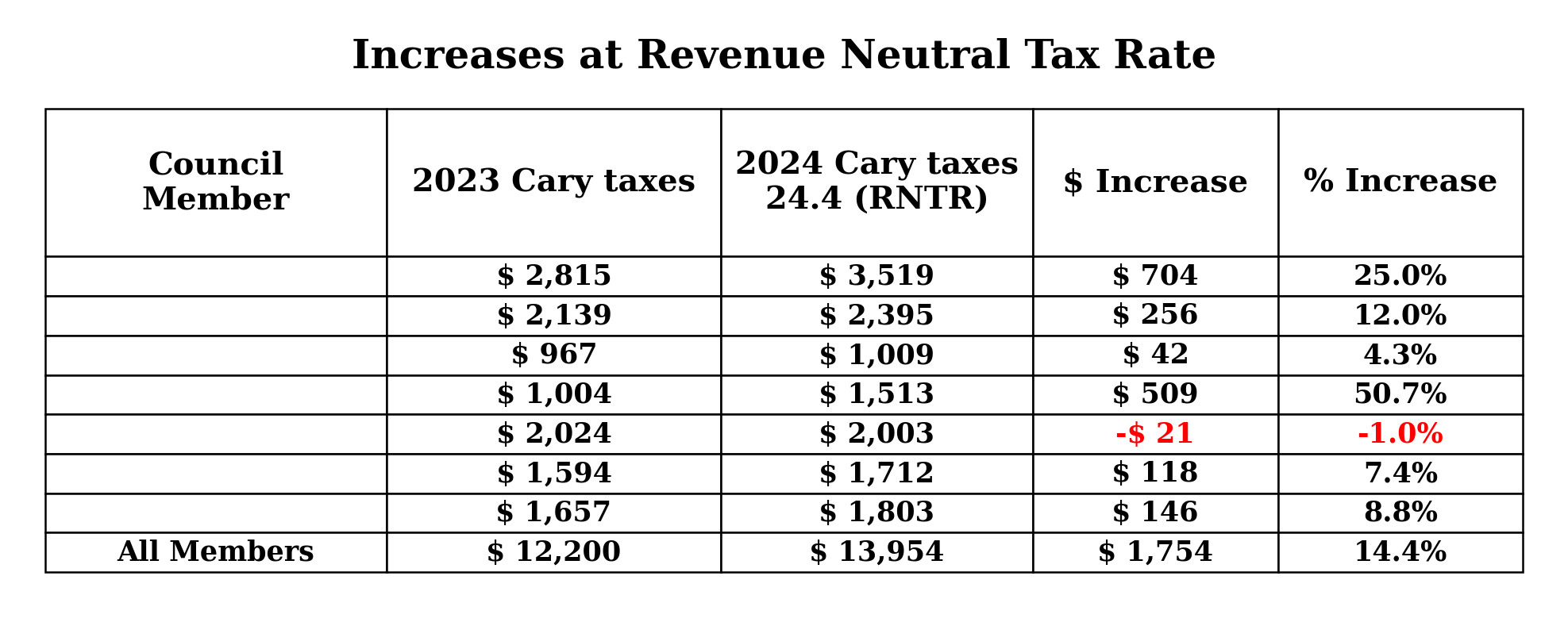
Thus, the figures show that the Town's published Revenue Neutral Tax Rate, if adopted, would have raised the Council members' taxes by an aggregate 14.4%. All homeowners in Cary would have suffered similar increases. Manifestly, the statutory Revenue Neutral Tax Rate was not, in fact, revenue neutral.
In fact, the Council [unanimously] adopted a rate of 32.5 cents per $100 of value, a staggering increase that is discussed elsewhere on this site. The goal of this article is to demonstrate with numbers that are easily checked that the statutory Revenue Neutral Tax Rate is unquestionably not revenue neutral.
Its other goal is to suggest that it's critically important to listen carefully when politicians and administrators talk about the 2028 tax rate. If a speaker compares the proposed tax rate to the Town's rate of last year, this is an attempt to deceive. Even more misleading is a comparison of the proposed rate with the rates of other Wake County towns.
North Carolina General Statute 159-11. Preparation and submission of budget and budget message.
(a) Upon receipt of the budget requests and revenue estimates and the financial information supplied by the finance officer and department heads, the budget officer shall prepare a budget for consideration by the governing board in such form and detail as may have been prescribed by the budget officer or the governing board. The budget shall comply in all respects with the limitations imposed by G.S. 159-13(b), and unless the governing board shall have authorized or requested submission of an unbalanced budget as provided in subsection (c) of this section, the budget shall be balanced.
(b) The budget, together with a budget message, shall be submitted to the governing board not later than June 1. The budget and budget message should, but need not, be submitted at a formal meeting of the board. The budget message should contain a concise explanation of the governmental goals fixed by the budget for the budget year, should explain important features of the activities anticipated in the budget, should set forth the reasons for stated changes from the previous year in program goals, programs, and appropriation levels, and should explain any major changes in fiscal policy.
(c) The governing board may authorize or request the budget officer to submit a budget containing recommended appropriations in excess of estimated revenues. If this is done, the budget officer shall present the appropriations recommendations in a manner that will reveal for the governing board the nature of the activities supported by the expenditures that exceed estimated revenues.
(d) The budget officer shall include in the budget a proposed financial plan for each intragovernmental service fund, as required by G.S. 159-13.1, and information concerning capital projects, grant projects, and settlement projects authorized or to be authorized by project ordinances, as required by G.S. 159-13.2.
(e) In each year in which a general reappraisal of real property has been conducted, the budget officer shall include in the budget, for comparison purposes, a statement of the revenue-neutral property tax rate for the budget. The revenue-neutral property tax rate is the rate that is estimated to produce revenue for the next fiscal year equal to the revenue that would have been produced for the next fiscal year by the current tax rate if no reappraisal had occurred. To calculate the revenue-neutral tax rate, the budget officer shall first determine a rate that would produce revenues equal to those produced for the current fiscal year and then increase the rate by a growth factor equal to the average annual percentage increase in the tax base due to improvements since the last general reappraisal. This growth factor represents the expected percentage increase in the value of the tax base due to improvements during the next fiscal year. The budget officer shall further adjust the rate to account for any annexation, deannexation, merger, or similar event.
(1927, c. 146, s. 6; 1955, cc. 698, 724; 1969, c. 976, s. 1; 1971, c. 780, s. 1; 1975, c. 514, s. 4; 1979, c. 402, s. 2; 2003-264, s. 1; 2024-1, s. 1.1(b).)