DEPARTMENT OF THE ENVIRONMENT
TOWN OF CARY DEPARTMENT OF THE ENVIRONMENT
The planet is in crisis. Wildfires now rage with unprecedented size and intensity, their smoke poisoning millions of lungs. Landslides tear through mountainsides, storms severely erode streambanks, and unchecked and unscientific development strips away the natural defenses that once buffered us from disaster. Forests fall, the air grows dirtier, our waters turn toxic, and communities everywhere are suffering.
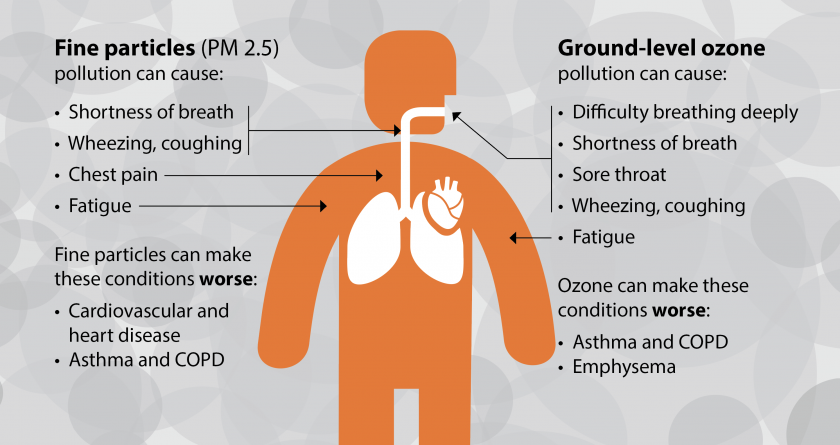
Extreme heat is killing the elderly, the poor, and outdoor workers. In the first two months of summer 2026, 16,000 people died of heat-related injuries in Europe. Flooding swallows homes, vehicles, and people, contaminates drinking water, and forces families to flee. Increasing numbers of children everywhere wheeze from asthma and a host of other pulmonary diseases directly caused by polluted air; survivors of fire and flood struggle with trauma, loss, and financial ruin. Entire neighborhoods become unlivable, while hospitals and social systems buckle under the strain.
Yet the response from leaders remains timid, fragmented, and dangerously slow. Science and experience demand bold action – cutting emissions, protecting and expanding green spaces, and investing in resilience – but too often politics, profit, and inertia win out. Citizens raise their voices and grassroots groups fight on the frontlines, but the system drags its feet. The disasters are no longer warnings – they are here, they are deadly, and unless urgent change comes, they will define our future.
In 2013, Cary restructured its departmental organization. Two of the largest departments were divided into four smaller ones. The Engineering Department was eliminated and replaced by the Transportation and Facilities Department and the Water Resources Department. The Public Works & Utilities Department was split into two separate departments. Two new Assistant Town Manager positions and a Deputy Town Manager position were created. It was the largest restructuring undertaken by the Town in 20 years.
The Town is now faced with the question: Are we in our small jurisdiction going to attempt to halt the degradation of our environment? More specifically, the question is: Are we going to shift our efforts from what we are doing now — slowing the rate of continued degradation — to reversing that degradation?
If the answer is YES — if we are indeed going to reverse the degradation — then the full power of the Town's Executive Branch must be focused and armed to deal with the various causes of that degradation. The way to begin the offensive is to unite the various sustainability and remediation initiatives now operating within the Town's bureaucratic framework into one focused department, frame and refine its mission, and invest it with the authority to accomplish that mission. This is why I propose that Cary create its own Department of the Environment.
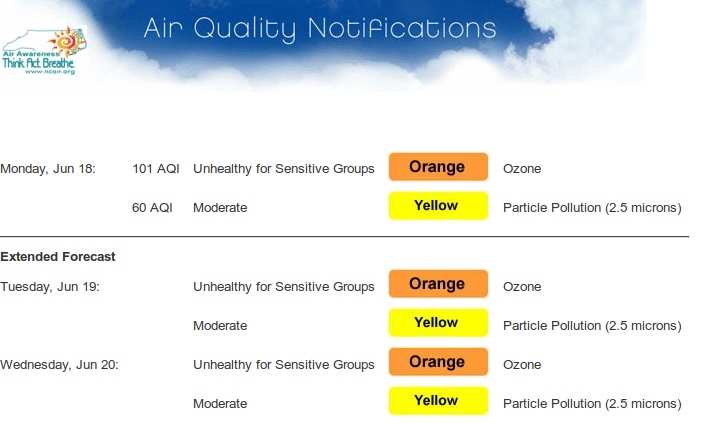
There were four days so far this year when the Air Quality Index in Cary was in the Orange Zone. This zone means that there are at least 150 parts per million of pollutants [in addition to the 424 ppm of carbon dioxide] in the atmosphere. And this is in a town that has no heavy industry, no manufacturing or generating plants emitting noxious smoke from their chimneys, and only one nearby mining operation. Almost certainly the cause of the extremely high concentration of pollutants is exhaust from the ever-increasing number of vehicles. This is what is causing the children of Wake County to have ever-increasing rates of asthma and other pulmonary diseases. We are causing our children to be sick!
With development moving apace, the number of days with dangerous air will increase and continue to rise year after year. An AQI in the Orange Zone means that "active adults . . . should limit outdoor activity." Active adults! It is this problem that requires a strong and focused Department of the Environment to work toward improving the quality of the Town's air and thus the quality of life of its citizens.
The liquid substance in Lake Crabtree looks more like chocolate milk than H2O. That is caused by soil erosion and stormwater runoff. Below is but a single example of runoff and erosion coming directly from a Cary townhouse development onto an adjacent shopping center's parking lot, then directly into a storm drain that will channel it into Lake Crabtree [and then on to our fellow citizens Down East].
I understand the argument that Durham and Raleigh also contribute to the horrendous quality of the water in Lake Crabtree. However, if the water is ever to be improved, some Town must be the first to begin that improvement. Cary often deems itself a leader. Here is a chance to lead.
We were told by Cary authorities that there are no Town ordinances that prevent this situation, and that what is shown in the video is not illegal. A Cary Department of the Environment could — at the very least — work with the developer and landscaper to improve grading and sloping practices and suggest the proper planting of trees and bushes that would absorb some of the rainfall. Note that it is not raining at all during the video. The water is being pumped out of the development's retention pit long after a rainstorm that "dumped" 1.25 inches of rain in a three-hour period.
A retention pit is used to reduce the "peak" runoff rate to an amount that meets an arbitrary (and essentially meaningless) requirement. It does nothing to reduce the total amount of water that runs off the development, nor does it — or any other current ordinance, statute, or law — prevent soil from eroding into our drainpipes, lakes, and rivers. This is a problem that must be addressed, and the best organization to do it would be a Cary Department of the Environment, if for no other reason than that no Town organization is now working on the problem.
The examples below are not offered merely as projects that Cary might copy. They are intended to show what cities around the world are actually doing at the leading edge of environmental restoration, stormwater management, climate adaptation, urban cooling, and ecological design.
Cary frequently describes itself as being at the “top of the arc.” That phrase ought to mean something. A community genuinely at the forefront should know where the state of the art lies and ask how close its own policies and projects come to it. The projects below provide some useful points of comparison.

SEOUL: RESTORING A BURIED URBAN STREAM
Seoul removed roadway infrastructure and restored 5.84 kilometers of the Cheonggyecheon stream through the heart of the city. The project created a long green corridor, restored flowing water and public access, and turned infrastructure once dominated by automobiles into an ecological and civic space.
Read about the project at the Seoul Metropolitan Government.

SINGAPORE: TURNING A CONCRETE CANAL INTO A LIVING RIVER
Singapore demolished a concrete drainage canal and replaced it with a naturalized, meandering river in Bishan-Ang Mo Kio Park. The adjoining park doubles as a floodplain during storms, while bio-engineered banks provide habitat, control erosion, and bring people directly to the water.

ROTTERDAM: A PUBLIC SQUARE THAT BECOMES A RESERVOIR
Benthemplein is both a neighborhood public space and stormwater infrastructure. In dry weather its basins are used for recreation; during heavy rain they collect runoff from the square, nearby streets, and rooftops. The three basins can temporarily store about 1.7 million liters of water, reducing pressure on the sewer system.

COPENHAGEN: DESIGNING A NEIGHBORHOOD FOR CLOUDBURSTS
Tåsinge Plads was Copenhagen’s first climate-adapted urban space. More than 1,000 square meters of asphalt were replaced by a green public landscape designed to capture, delay, infiltrate, and evaporate stormwater. The square can manage rain falling over a surrounding area of roughly 8,000 square meters while remaining a neighborhood gathering place.

MADRID: BURYING A HIGHWAY AND GIVING THE RIVER BACK TO THE CITY
Madrid placed a major section of its M-30 ring road underground and transformed the land along the Manzanares River into Madrid Río, an enormous connected green corridor. The project reconnected neighborhoods with the river and added tens of thousands of trees and hundreds of thousands of shrubs where traffic infrastructure had dominated the landscape.
.jpeg)
MILAN: PUTTING A FOREST ON TWO RESIDENTIAL TOWERS
Stefano Boeri’s Bosco Verticale integrates living vegetation into high-rise architecture rather than treating landscaping as decoration around the building. Its two towers contain about 800 trees, 4,500 shrubs, and 20,000 plants representing roughly 100 species, creating habitat and substantial vegetation on an exceptionally small urban footprint.